Ryan Louder
The King That Lost It All by Ryan Louder
The King That Lost It All by Ryan Louder
Couldn't load pickup availability
Signal Rating: 9/10 — Strong
Classification: Hallucinatory
This painting by Ryan Louder is part of a body of work shaped by his neurological condition — Narcolepsy with REM Intrusion Hallucinations, clinically confirmed via MSLT at Guy's Hospital, London. The work contains hallucinatory imagery — geometric form constants, phosphene-like patterns, and perceptual structures consistent with REM intrusion.
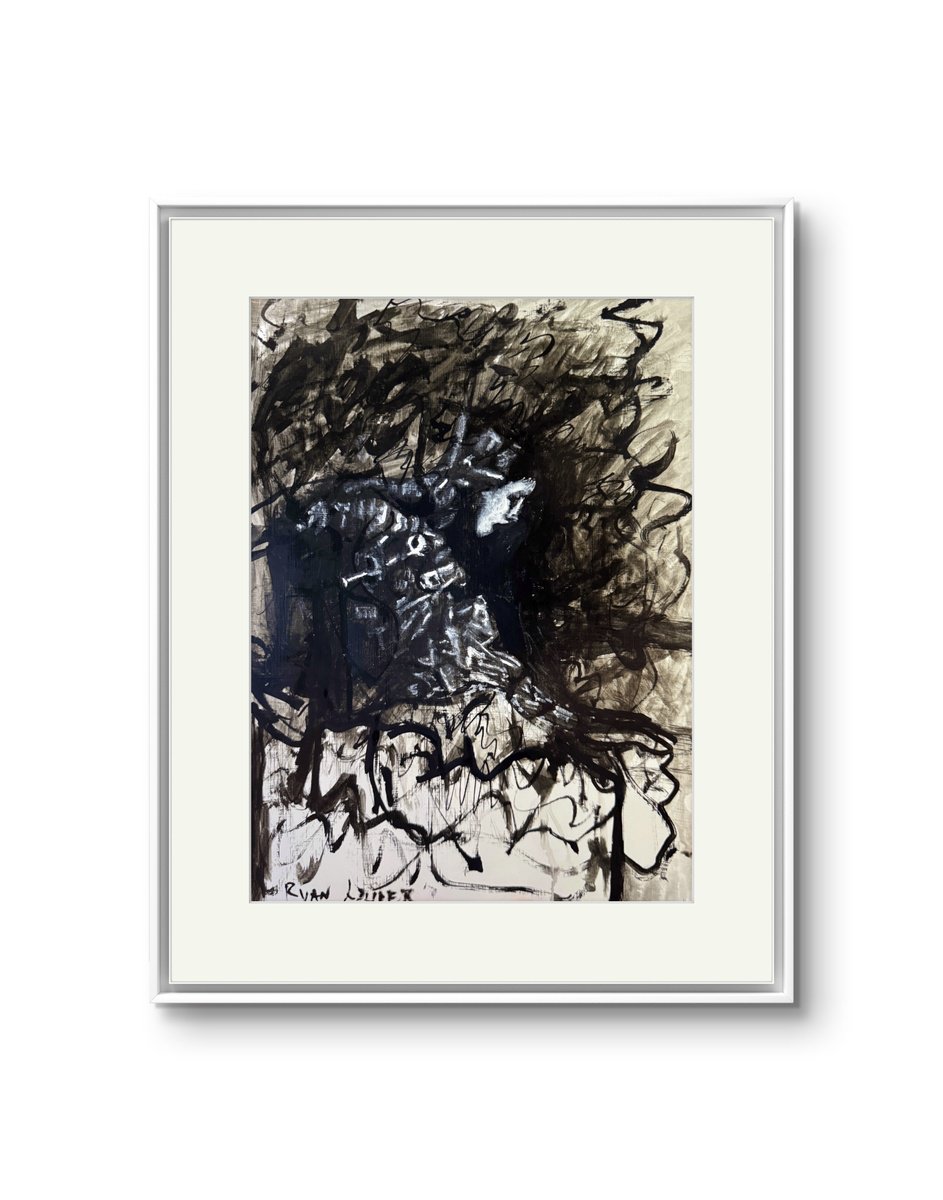
Neuroaesthetic markers identified: extreme case — chaotic black mark-making engulfs and partially dissolves the central figure; layered scratching and smearing creates visual noise consistent with REM intrusion static; figure is ambiguous — could be collapsing or being consumed; frenzied linear energy radiates outward from centre in all directions suggesting thought-storm or seizure of perception; white highlights scattered across the dark mass function as disorganised phosphene-like flashes; figure's face almost entirely lost — identity dissolution at maximum; title reinforces collapse of self-concept; technically and neurologically one of the most hallucinatory works in the series
These markers are not deliberate artistic techniques but direct visual recordings of what REM intrusion hallucinations look like. The imagery emerges from neurological experience, not metaphor. Ryan has painted over 2,000 works, with over 1,000 originals sold. Each painting in this collection has been subjected to neuroaesthetic forensic analysis to identify and catalogue the perceptual phenomena present.
The surface is largely claimed by chaotic black mark-making — looping, scratching, smearing gestures in ink or charcoal radiating from a compressed central zone across a white ground. Within the dark mass, a figure is partially legible: a pale suggestion of a face in three-quarter profile at upper centre, white highlights scattered across the body reading as involuntary phosphenic points rather than described light. The lower half opens to white paper where marks thin, but looping lines continue without resolution even there. The figure appears to be collapsing or engulfed rather than standing. No edge of the figure is cleanly bounded; every outline is overrun by the surrounding storm.
Share